Lighting Colour Temperature
The colour that a light bulb produces is referred to as its "temperature." This doesn't refer to how physically hot the bulb gets, but rather the shade of white light it produces.
- Warm white is a yellow-toned light. This is what many people consider to be the traditional, normal colour for home light bulbs. Think of it as the natural light of a summer evening.
- Cool white is a fairly neutral colour with a very slight yellow undertone. It mimics the natural light of a cloudy spring day.
- Daylight white has a slight blue tinge, similar to a bright winter day.
How is Colour Temperature Measured?
Light travels in waves, and the wavelength determines the colour your eyes perceive. This perceived colour is measured in Kelvins (K). The Kelvin scale is inversely related to wavelength: lower Kelvin ratings produce the warmest light, while higher numbers produce cooler light.
The lights we stock at My Green Lighting range from 2200 Kelvin to 6700 Kelvin. To keep it simple, you can group them into three main bands:
| Kelvin Rating |
Colour Description |
| 2000K – 3500K |
Warm White |
| 3501K – 4999K |
Cool White |
| 5000K+ |
Daylight White |
What Names are Used to Describe Light Colour?
To make things a bit more complicated, different lighting manufacturers use different words to describe these temperatures.
For example, 4000K is variously called cool white, neutral white, or natural white. Meanwhile, 6000K might be labeled as daylight white, natural white, or even cool white.
Very low Kelvin ratings, less than 2700K, are often described as very warm white, or extra warm white, or ultra warm white.
Tip: If you are ever in doubt, ignore the words on the packaging and always check the Kelvin rating number. The Kelvin numbers resolve all the word-based confusion.
Compare the Colours in Our Colour Box
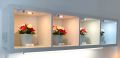
One of the most useful tools we have in our showroom is our "colour box." It demonstrates four different shades of white side-by-side. Almost every customer who visits us to buy a light bulb uses this box to make their final decision.
Which Colour Temperature Should I Use?
Ultimately, you should use whichever colour temperature you like best - it is entirely a personal choice. For instance, my own preference is to use warm white light everywhere at home, but that might not suit your space.
Here is what our customers and staff recommend based on how spaces are used:
- For Work Areas (Cool/Daylight White): Cool or daylight options are much better for task environments, especially if you do anything involving precise colour matching. If you enjoy photography, painting, or drawing, consider a cool white light. Our offices here at My Green Lighting are lit with 4000K (cool white) bulbs.
- For Relaxing (Warm White): Warm white lights are generally better for unwinding. We highly recommend warm white lights in living rooms and bedrooms to help you relax at the end of the day.
- For High Visibility (Daylight White): Some of our older customers have noted that the subtle blue tinge from daylight bulbs makes everything look sharper. This makes it much easier to see fine details, making daylight white an excellent choice for reading lights. Some people also believe that using Daylight white lights in the darker winter months can help to improve mood.
What are CCT lights?
If you don't know what colour to choose, or need different colour at different times then you should consider a CCT light. These are lights that have a switch to select the colour of the light they produce, providing the best option at all times.
Colour Rendering Index (CRI)
The colour rendering index of a light could be considered a measure of the quality of the light rather than the colour. It's a scale of 0 to 100. Natural daylight has a CRI of 100. A high CRI of 80 or more means that colours will be appear more accurate. A low CRI of less than 80 means that colors can look dull, washed out, or distorted. Think of the muddy, yellowish look of old streetlights
Most of the LED lights that we stock have a CRI of 80 to 90, which is the standard for normal, everyday lighting. There are also some high CRI products designed especially for retail displays, or anywhere the colour is important.
Enjoyed this article? Tell your friends:
More articles